Supervision: Session Notes From the World's Therapist - October 17, 2025
Daily serialized fiction

We all feel it - so much changing. The way we think. The way we work. The way we pay attention.
In response to these changes I am teaching three lives classes in November:
How to build an idea that holds weight.
How to build a career when the job market no longer makes sense.
How to design your information diet so you don’t go insane.
One hour each offering real tools as we learn-by-doing. Join me. Let’s dig deep and find new responses to this world we’re living in.

If you’re new to this series read the Introduction here.
Ruth descended the narrow concrete steps to the basement office, the air cooling with each step. The building was old. Its corridors smelled faintly of iron pipes and old rain but a warm glow spilled from the half-open door at the end. Inside, Atlas’s space was nothing like the rest of the place: woven rugs on the floor, heavy curtains breathing slightly in the draft, a low lamp shaped like the moon.
Atlas looked up from her desk, eyes dark and steady. “Come,” she said simply. Ruth slipped inside, the door closing with a soft click. She sat in the familiar chair across from her supervisor and unwrapped her scarf.
Atlas is both woman and myth - born in Lagos, trained in London, and tempered by history. She holds not only the sky but also the sorrow that comes with seeing too much. Her voice carries both thunder and mercy.
For a moment, neither spoke. The clock ticked once, twice. Then Ruth said, almost to herself, “I don’t know how much longer I can hold it all.”
Silence.
“Well, you know, this is how I feel. The work is overwhelming, and I just can’t know everything. I never can. There’s so much learning to do about each person and each thing that it’s brought to me. And it kind of takes over my life, and I don’t know how to have... ...my own life, because this work is so... ...different, and I can’t share it with anyone. But I came to it because I was sick, and I had to rebuild my practice. And then this is what it’s become. But I don’t think I have enough... Sometimes, I don’t feel like I have enough of my own support. Maybe not even external support. I don’t know.”
“Mm. You sound like a woman standing in a river that keeps rising. You keep finding ways to breathe, but the current does not slow.
Tell me, Ruth, when you rebuilt your practice, did you also rebuild your boundaries? Or did you only rebuild your purpose?
Because what I hear is that you are holding the world without a counterweight. Even Atlas, in the oldest tellings, had pillars to bear some of the strain. Who or what, right now, shares the weight with you, even a little?”
“I love that you have pillars,” Ruth responds. “Can you tell me more about the pillars? I mean, what I have right now to share the weight is you. You who literally holds the world.”
“When I say pillars, I’m talking about the things that stand between me and collapse. In some tellings, they’re mountains - places where the sky meets the earth so the weight doesn’t fall all on me.
For me, they’re just… the things that keep me upright. Coffee in the morning. A song that cuts through the noise. Someone who remembers my name when I forget it. Those are my pillars. They don’t hold the world; they hold me.
Ruth, what are the few things - small, ordinary things - that hold you?”
“It’s definitely my coffee. And it’s the fall air. I love the fall. It’s my coloured scarves.”
Atlas smiles a little.
“Mm,” she says. “So you do have your pillars. Small ones, but loyal.”
Atlas looks out the window, watching the wind tug at the trees. “Fall is when I feel closest to the world,” she says softly. “Everything letting go at once, and somehow that’s what keeps it alive.”
She lets the silence stretch, enough for Ruth to step into it if she wants.
And she does. “It all seems hopeless, really. Like nature’s right here to teach us what we need to learn and yet we are not learning it.”
Atlas exhales, slow. “I know,” she says. “It’s like watching a child you love run toward the fire, again and again.
But nature isn’t trying to teach us, Ruth. She just is. We’re the ones who keep turning her into a classroom because we’re afraid of what it means if there’s no lesson.”
“You don’t think nature is teaching us? You think we’re just adrift? How can that be? It doesn’t seem right.”
Atlas’s gaze softens. “I didn’t mean she doesn’t have anything to offer,” she says quietly. “Only that she doesn’t care if we learn. The river runs whether you understand it or not. The tree drops its leaves without asking if you’re ready. Maybe that’s the lesson itself - that life keeps going with or without our comprehension.
We keep wanting meaning to be merciful. But maybe it’s just.. honest.
Nature is always teaching. But she doesn’t soften her tone for us. She teaches through decay, through hunger, through the storm that takes what isn’t rooted deep enough. We call it tragedy. She calls it balance.”
Her eyes lift to meet Ruth’s. “Hopelessness isn’t wrong. It’s just what you feel when you finally see how much she loves what she keeps taking away.”
Ruth responds, “It strikes me that we’re so, so small. Like, the planet’s been around for billions of years, and we just appeared recently, and yet we fight to control it and to control anything whatsoever. And we miss everything when we do that, but it seems to be our nature to do it. It’s very hard to let things be as they are. And why are some humans able to find that and others not? I would say it all has no meaning, except all the intelligence in the world can’t be created from nothing. Like, I don’t believe that. It seems insane that it’s all from randomness, but I don’t know.”
Atlas considers for a long moment before she answers.
“You’re right we are small. I feel that every time I touch the world. The odd thing is, for all our arrogance, we’re the only creatures who know we’re small. That’s the crack where wonder leaks in.”
Then, quieter: “About meaning: every time I’ve tried to prove the world empty, something alive gets in the way. A rhythm. A symmetry. I don’t know if intelligence was created from nothing or from something, but I do know it keeps being born with nothing, not from it. Right now. Every moment.”
She lets the last sentence hang, like a doorway left open.
“I don’t understand what you mean about intelligence being born with nothing.”
Atlas nods. “I mean this,” she says. “We keep looking for a source - as if intelligence, life, meaning - must come from somewhere, a maker, a plan. Maybe it did, maybe it didn’t. But every day, right now, it keeps emerging out of emptiness.”
She gestures toward the space between you. “When a baby takes its first breath, when a thought arrives you didn’t expect, when silence suddenly gives rise to music - that’s intelligence being born with nothing, not from it. It needs the open space to appear.”
She smiles faintly. “Maybe that’s what creation really is. Not an origin. A rhythm.”
“Say more.” Ruth says.
Atlas leans back, thinking. “Creation isn’t a single act,” she says. “It’s the constant conversation between what exists and what doesn’t yet. Between fullness and void. That rhythm - presence answering absence - is where intelligence lives.”
Her hand drifts toward the air as if shaping something unseen. “When everything is filled, when we crowd the world with noise, control, explanation… nothing new can enter. The empty space frightens us, but that’s where the next thing breathes in.”
She looks at Ruth again. “So intelligence isn’t a property. It’s a relationship. The moment stillness meets motion, matter meets possibility. That’s why it keeps being born - it doesn’t belong to anyone. It’s what happens when there’s room.”
“Can you make this a bit more concrete?” Ruth asks.
“Think of it this way. When everything is already known or controlled, nothing new can appear. Creation needs a gap - some emptiness - for anything to form. A pause between thoughts. A breath between waves.
So when I say intelligence is born with nothing, I mean that life keeps inventing itself out of space, quiet, uncertainty. The universe isn’t a finished thing - it keeps happening wherever there’s room to happen.
That’s what I mean by rhythm: being and nothingness taking turns.”
“So then the best thing I can do is create as much space as I can inside myself so that the people I work with find space for something new.” Ruth realizes.
Atlas’s eyes soften. “Yes,” she says. “That’s the whole art of your work, Ruth. Not to fix, not to fill - but to make room.”
When you carry too much, your presence becomes crowded. But when you can hold stillness inside you, even for a breath, others feel it. They start to breathe differently. Their own space opens.
It’s not passive. It’s the hardest discipline I know: to stay spacious in a world that keeps trying to close.”
“I’m tired.” Ruth says.
Atlas’s tone gentles. “Then rest,” she says. “Even the sky I hold goes dark each night. That’s how it renews itself.”
She studies you for a moment. “You don’t have to understand everything before you sleep. The work will still be there. Let the world hold you for a while.”
She leans back, quieter now. “That’s the real supervision - learning when to stop carrying.”
The room had grown dim. The late light slid across the floor in long gold bands, touching the rim of Atlas’s mug, the spines of the books that leaned into one another like tired friends. A faint scent of sandalwood and paper hung in the air. The hum of traffic outside was distant, softened by the thick glass.
Ruth stood slowly, pulling her scarf around her neck. For a moment she rested her hand on the back of the chair, as if leaving a trace of herself there. Atlas didn’t rise she only nodded, once, in that way she had that meant both go and you are seen.
Finally outside, the air was sharper than it had been an hour ago. Ruth felt the weight of the world settle differently on her shoulders - still heavy, but quieter.
We meet online, but the real work happens off-screen. A reminder to all of us to step outside, feel the earth beneath our feet, take a breath of fresh air, and remember who we really are.
If you want to share this post with someone you know, here is an easy way to do it (I really appreciate your support):
To receive Ruth’s daily session notes by email:
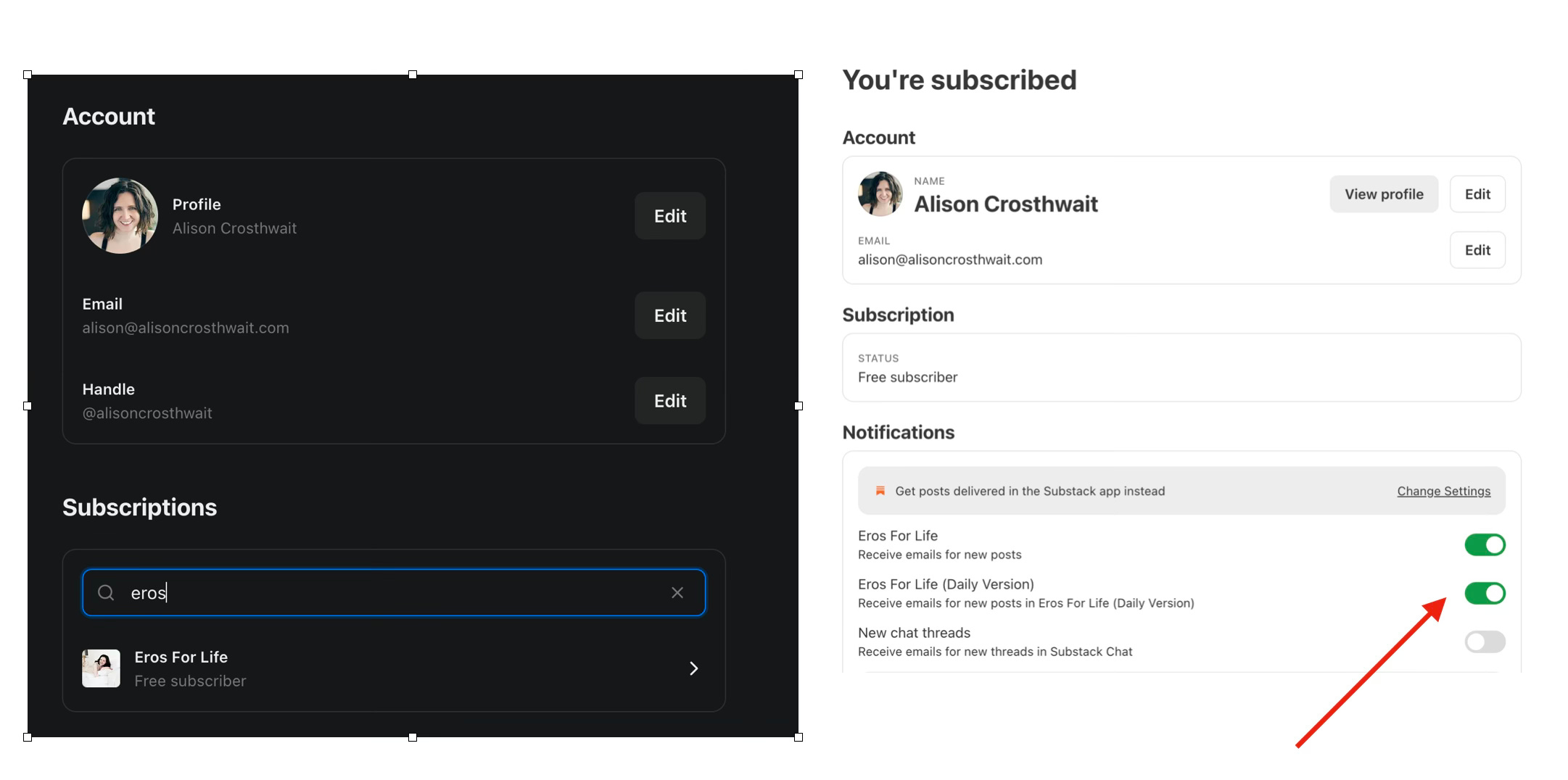
From your laptop go to. your profile. Visit the Eros for Life Page and activate Eros for Life (Daily Version). See photos below.
You can also follow along on The Aliveness Podcast.